
Animal Print Nails: Why Hand-Painted Patterns Are All About Arrangement
Animal print nails and abstract nail art use the same two-layer logic: a brush creates basic marks, then spacing, scale, direction, and offset turn those marks into a readable pattern.
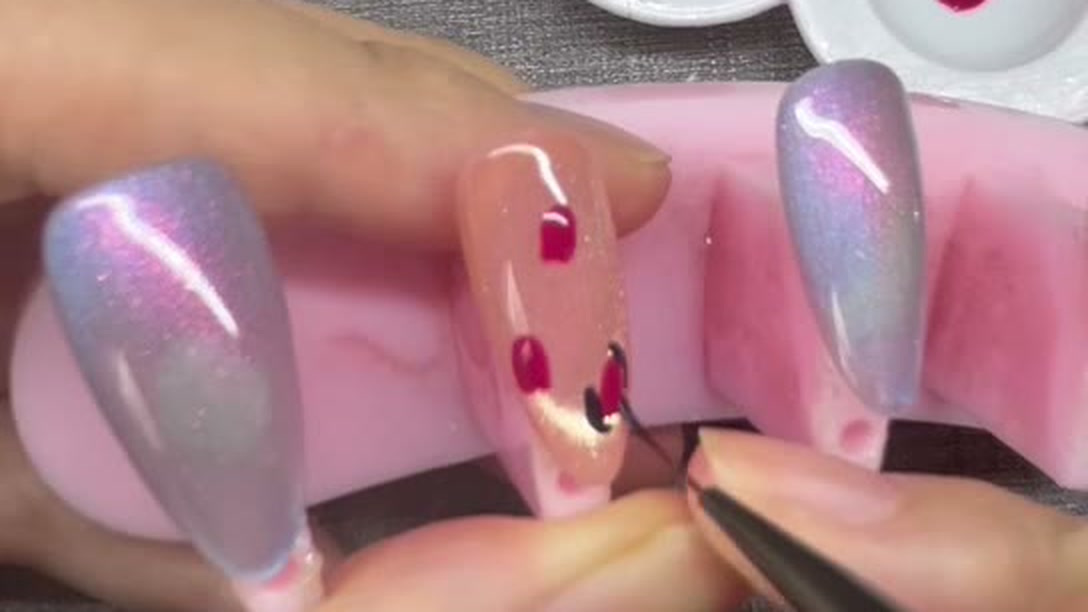
Look closely at a hand-painted leopard pattern and many dark outlines stop before they close. Some marks cover one side of a burgundy patch, others break into two short sections, and the openings face different directions. Those unfinished edges make the pattern feel like fur rather than a row of stickers.
The direct definition: animal print nails are built in two layers. A brush creates basic marks, and arrangement turns those marks into a pattern. Arrangement can be read through four variables: spacing, scale, direction, and offset.
This article is for brands and sourcing teams reviewing hand-painted press-on samples. It also gives a first-time buyer a way to understand why two sets with similar spots can look completely different. It explains the visual system rather than providing a home tutorial or tool list.
Key Takeaways
- A clean individual mark is only the first layer; the spacing and rhythm of the full surface create the pattern.
- Animal print uses the four variables to look recognizable, while abstract nail art uses the same variables to create balance and tension.
- Hard and soft edges change both the visual character and the labor involved. A hard edge is placed decisively; a soft edge is carried while the color is still open.
- Hand-painted patterns show small directional differences between units. Printed patterns repeat the same relative positions.
One Brushstroke Is Not Yet a Pattern
A dotting tool can make a circle and a liner brush can make a line. Those are the building blocks of animal print nail art, but they do not define the finished surface. There are two different decisions after the mark is made.
One decision is to copy a known shape, such as a five-petal flower. The reference tells the artist how many petals, how wide they are, and where the center belongs. The other decision is to arrange a group of shapes without a single correct spot to copy. A leopard patch can be larger or smaller, closer or farther from its neighbor, and open on a different side while still working as part of the surface.
That is why animal print nail designs should be judged as a field rather than by one isolated patch. A painter can make a very clean spot, but if every spot is identical and evenly aligned, the set looks artificial. Small variations in the marks can feel more natural when the distribution has rhythm.
Four Arrangement Variables Behind Animal Print Nails
Arrangement can be broken into four practical variables.
Spacing controls whether the base color remains visible. If spots touch too often, they merge into one block. If they are too far apart, the pattern loses recognition. A useful distribution keeps openings between units while varying the gap slightly.
Scale prevents the pattern from looking copied. If every spot is the same size, the surface resembles a repeated stamp. If the size difference is extreme, the design looks like two unrelated systems. A dominant size with a few smaller or larger accents creates hierarchy.
Direction gives the pattern movement. When every opening faces the same way, the surface can become a grid. When every mark points randomly, the design loses flow. Strong samples let most units follow the nail's direction while a few turn against it.
Offset breaks mechanical rows. Perfect alignment reads like tile. Shifting a neighboring row by part of a unit creates a more natural rhythm, much like a staggered brick wall.
| Arrangement variable | Too far | Controlled result | Pattern example | What to inspect |
|---|---|---|---|---|
| Spacing | Spots merge or become unrecognizable | Base color shows through with varied gaps | Leopard, cow, and scale-like patterns | Is the base visible between units? |
| Scale | Every unit is identical, or sizes split into two systems | A dominant size with a few accents | Small leopard spots or large cow patches | Is there hierarchy rather than duplication? |
| Direction | All openings align, or marks scatter without flow | Most units follow the nail with a few interruptions | Zebra slants and tiger arcs | Do openings and strokes change direction? |
| Offset | Rows line up mechanically | Neighboring units shift across the surface | Scale grids and abstract blocks | Are adjacent rows staggered? |
These variables explain why different animal print nails can share a method. Short irregular blocks with scattered dots suggest leopard. Uneven angled bars suggest zebra. A filled grid can suggest snake texture. Large blunt patches suggest cow print. The design family comes from the arrangement, not simply from naming an animal.
Hard Edges and Soft Edges Change the Finish
The edge of a mark determines whether the pattern feels graphic, organic, or blurred. A hard edge is placed with enough pigment to hold a clean boundary. Once it is set, a second corrective stroke often creates a doubled line. A soft edge is carried while the color is still open, leaving a lighter transition instead of a fully pressed boundary.
Zebra stripes, cow patches, and the outer ring of a leopard spot usually need a clear edge. The ends of tiger arcs and transitions in abstract blocks can use a softer edge. A single set can use both: a firm outer shape with a softer change inside the shape.
Leopard patterns also use an intentional opening. A completely closed dark ring reads like a circle. Broken outlines, different opening directions, and a few small dots in the empty areas create the interrupted quality associated with fur. The production correction is specific: a hard edge that has been doubled usually needs to be removed and repainted; a soft edge that has spread too far may need the base color restored before the mark is rebuilt.
Bench image: a broken dark outline is added around burgundy patches, with the line intentionally left open.

Finished sample: varied spot sizes, opening directions, and scattered small marks create a non-repeating surface.
Abstract Nail Art Uses the Same System Without a Recognizable Animal
Remove the requirement that the viewer identify an animal and the same four variables still work. Abstract nail art is judged by relationships between lines, blocks, and empty space rather than by resemblance.
Three common directions make the difference visible. Abstract line nail art relies on line weight, spacing, and crossing angles. Minimalist abstract nail art reduces the number of elements and lets empty space carry part of the composition. Abstract French nails borrow the French tip boundary but replace the expected arc with an irregular block or broken line.
In each case, the variables remain the same. Line art emphasizes direction and spacing. Minimal designs emphasize the proportion of open space. Abstract French designs emphasize offset within the tip boundary. That is why abstract nail designs can look unrelated while still belonging to one visual system.
Base Color and Nail Shape Set the Limits
The base must provide enough value contrast for the marks to remain visible. A black pattern on a deep brown base can disappear at wearing distance. A simple check is to view the sample in grayscale: if the pattern and base nearly merge, the design will need stronger separation.
Surface texture also matters. Glitter, cat-eye, and other reflective bases create their own highlights underneath the pattern. A thin abstract line can be visually interrupted by those highlights, while a larger animal-print patch usually remains readable. Glitter animal print nails work when the patches are large enough to hold their outline.
Nail shape changes the available arrangement area. A short nail needs fewer, smaller units. A long nail can carry more spacing, but copying a short-nail layout onto it leaves a bare center. On a stiletto, marks near the tip need to become smaller or more tapered as the surface narrows. Animal print almond nails have more room than stiletto shapes, but the tip still needs a controlled reduction.
An animal print French tip creates its own stopping line by keeping the pattern in the tip band. That structure limits density and leaves the nail body quiet. Base color, length, and shape should therefore be reviewed together rather than approved as separate choices.
How to Tell Hand-Painted Arrangement From Print
Repetition is the fastest clue. Compare two neighboring units. In hand-painted work, spacing, angle, opening, and scale vary slightly, and the variation follows the surface direction rather than appearing as random noise. A printed image preserves the same relative positions wherever it is repeated.
Edges provide a second clue. Hand-painted edges can contain tiny brush irregularities and occasional open points. Printed edges tend to show a regular raster, even sawtooth, or consistent registration offset. Layered hand paint can also show a slight difference between the base and the darker stroke; a printed image is flatter because it is formed at once.
Look at the whole nail last. A hand-painted arrangement usually responds to the narrowing surface by reducing or shifting units. A fixed print does not understand the nail shape; it is simply cropped to fit. Terms such as animal print gel nails or animal print acrylic nails describe the material system, not whether the pattern was hand-painted or printed.
FAQ
Do animal print nails and abstract nail art use the same painting method?
They use the same two-layer logic: marks are created first, then arranged through spacing, scale, direction, and offset. Animal print aims for recognizable surface features, while abstract art aims for balance and tension. The difference is the judgment standard, not the basic arrangement system.
How can you tell whether animal print nails are hand-painted or printed?
Look for repetition and edge behavior. Hand-painted units have small differences in distance, angle, opening, and scale, while printed units preserve identical relative positions. Hand-painted edges may show tiny brush irregularities; printed edges tend to repeat the same raster or registration pattern.
How do you do animal print nails, and what should a buyer inspect in a finished set?
The finished sample is best judged by its arrangement rather than by copying a tutorial step. Check whether spacing leaves a controlled amount of base visible, whether sizes have hierarchy, whether directions follow the nail with a few interruptions, and whether neighboring rows are offset. Then inspect the edge quality and whether the pattern adapts to the nail shape.
Do hand-painted animal print nails wear off quickly?
The painted pattern does not determine wear by itself. The top coat must cover the surface and edge continuously, and every color layer must be cured according to its product instructions. Edge lifting or haze points to a finishing or curing issue rather than to the animal-print method.
Why Arrangement Experience Matters
The value in hand-painted animal print nails is not just the ability to draw a spot. It is the ability to make dozens of marks read as one surface: varied enough to avoid repetition, controlled enough to follow the nail shape, and finished with edges that look intentional.
Those decisions come from repeated batches and rework records. Artists learn where a hard edge should stop, how much empty space keeps a pattern legible, and when a small correction will create a doubled line. Training and production stay connected so that these judgments can be taught and checked instead of remaining in one person's memory.
For a hand-painted pattern matched to your base colors, shape, and customer profile, contact EverJoy Nail.
For the small marks and open space behind simple pattern layouts, read why dots, lines, and negative space are effective nail designs. For the sources of variation in hand-painted sets, see why every hand-painted nail set looks slightly different. For the difference between blooming gel and water marble color flow, read how blooming gel and water marble create spreading patterns.