
From Reference Image to Press-On Nail Production Brief
Learn how to turn a press-on nail reference image into a production brief with clear design specs, rights checks, open questions, and supplier review.
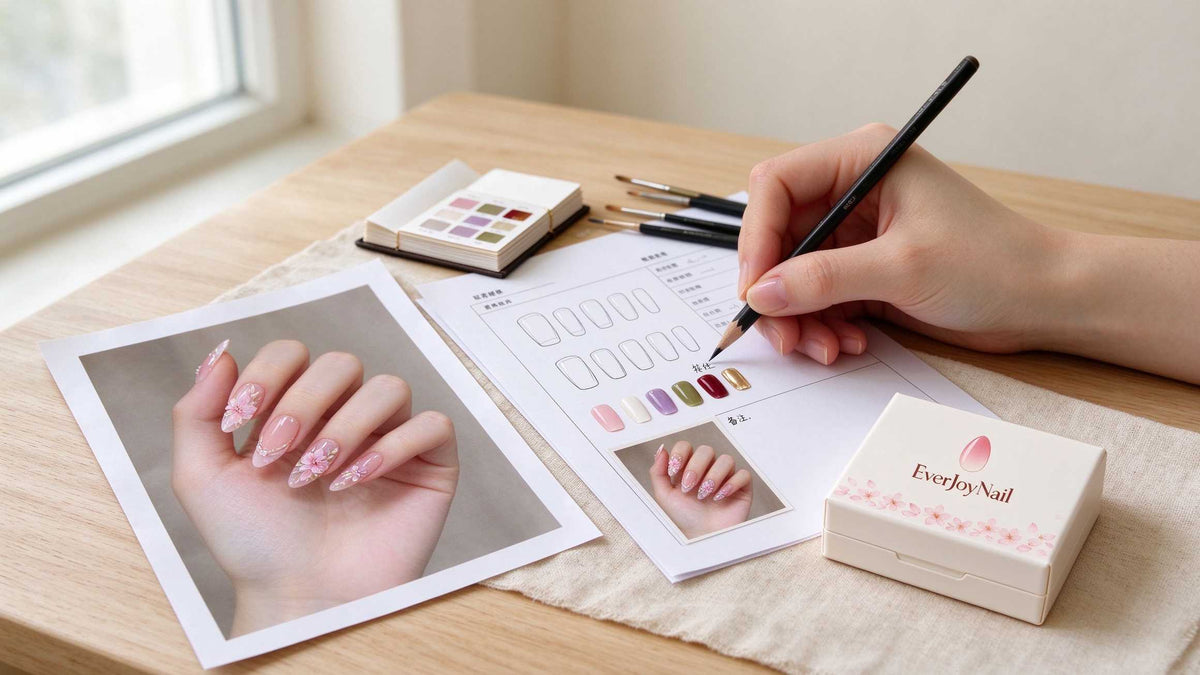
From Reference Image to Press-On Nail Production Brief
A picture can communicate a design direction, but it rarely contains every detail a maker needs to quote and sample a press-on nail set. To request press on nails from a picture, translate visible features into written specifications, mark what cannot be determined from the image, and ask the supplier to confirm feasibility before sampling.
This is an illustrative planning exercise, not a documented customer project. The example below shows how a brand team could work from a reference image; it does not describe an actual EverJoy order or guarantee that a design can be reproduced.
Start by separating observation from assumption
Before writing a specification, make two lists: details that are actually visible and decisions the image cannot settle. This prevents guesses from becoming unintended requirements.
| Visible or reasonably describable from the image | Not established by the image alone |
|---|---|
| Overall style and color relationships | Exact color values or physical color match |
| Approximate silhouette, if the nail is clearly shown | Exact shape, length, or dimensions without a scale or product reference |
| Visible decorative elements and their approximate placement | Material, thickness, attachment method, or raised height |
| Apparent surface appearance | Exact finish, texture, durability, or feel |
| Visible composition of the photographed set | Size range, sizing method, set contents, or packaging |
Record unknowns as questions. For example: “Is the gold detail foil, metallic pigment, or another effect?” is more useful than silently assuming a material. Lighting, camera settings, screen display, cropping, and image processing can all affect what a buyer sees. The color matching guide explains how to prepare color references.
Translate the image into brief fields
Use the image as a reference, then write down the requested product attributes in terms the supplier can review. The exact terms and available options should be confirmed with that supplier.
| Design cue | Brief field to specify | Example of a useful instruction |
|---|---|---|
| Silhouette | Shape and length | “Short almond; confirm available length options” |
| Color palette | Color direction and controlling reference | “Warm blush; see labeled swatch A; ask supplier to confirm matching method” |
| Surface appearance | Requested finish | “Gloss finish requested; confirm material and appearance on sample” |
| Pattern | Motif, placement, scale, and priority | “Small floral motif on ring-finger nail; placement is a priority” |
| Decorative element | Type, count, placement, and any size/height expectation | “One gold-tone accent near the center; propose a feasible material” |
| Set | Nail count, sizing approach, and size breakdown | “Confirm set contents and available sizing method before quote” |
| Presentation | Packaging, card, labels, logo, and barcode needs | “Retail card required; artwork file and dimensions pending supplier template” |
Mark each field confirmed, requested, or open. A request is not a supplier-confirmed capability, and an open field should not be treated as settled. For a fuller field checklist, see the custom nail design brief guide.
Apply the method to the supplied sample materials
The product-image folders supplied for this review include sample-display photos with visible examples of gradient color, floral motifs, glitter or metallic-looking accents, and raised decorations. These images can help a team identify which visual attributes to describe in a brief. They do not document the source reference, usage permission, production method, customer approval, or performance of a specific order.
| Visible example in the supplied display photos | Useful brief question | Do not infer from the photo alone |
|---|---|---|
| Gradient or multi-color palette | Which color areas are essential, and what swatch or code will control review? | Exact color values or repeatable color tolerance |
| Floral or other motif | Which nail carries the motif, and what placement or scale matters? | Artwork ownership or permission to reproduce it |
| Glitter or metallic-looking accent | What finish is requested, and what material options can the supplier confirm? | Whether the effect is foil, pigment, glitter, or another process |
| Raised decoration | What count, position, and visible profile are requested? | Attachment strength, comfort, durability, or packing suitability |
The supplied almond sizing diagrams also separate size groups labeled XS, S, M, and L and show measurements for individual nails. That is a useful reminder to specify shape and size independently from a style photo. Before publishing or quoting any exact measurement, verify the chart's units, measurement direction, revision, and the product/model it applies to; the provided chart images alone do not establish those details in website-ready text.
Treat the display photos and sizing diagrams as internal planning references unless image ownership and commercial-use permission are confirmed. They are not a traceable “reference image to brief to approved sample” case. The exact source-to-brief chain is still needed to substantiate a real case study.
Use a reference image without making it the whole specification
Avoid relying on “make it look like this.” Instead, state what the image controls and what may be adapted. A useful reference note might say:
Use image A for the overall palette and floral placement. The exact color and decorative material are open for supplier review. Keep the short almond silhouette; propose an original arrangement rather than copying unlicensed artwork.
That note gives the supplier a direction while preserving room to identify technical limits. If exact color matters, provide an additional swatch or color reference and ask how the match will be reviewed. If shape or length matters, name it separately instead of expecting it to be inferred from a cropped photo.
Address image rights and originality carefully
Before using a reference in a commercial project, record where it came from and what permission or license applies. A public social-media post is not automatically permission to reproduce the image or the specific artwork shown in it. The rules can depend on the source, rights involved, jurisdiction, and intended use; this article is not legal advice.
If permission is unclear, do not assume that changing a few colors makes a design safe to copy. Ask the rights holder or a qualified legal professional about the intended use. You can also ask the maker to develop an original design guided by broad attributes such as palette, mood, or general theme, while avoiding distinctive protected artwork, logos, or characters. The supplier can confirm what documentation it needs, but that confirmation does not replace legal clearance where required.
Keep the source URL or source details, permission documentation, and a note identifying which design elements are inspiration versus required original work. Do not send third-party artwork as a production file unless the intended commercial use is authorized.
Copy-and-fill production brief
Use this template to turn the reference into a reviewable handoff. Leave unknowns marked as open rather than filling them with assumptions.
PROJECT
Brand / project:
Target customer and sales channel:
Target market:
Design ID / planned SKU:

REFERENCE
Image filename or reference ID:
Source / creator:
Permission or license status:
What this image should guide (palette, mood, placement, etc.):
Elements that must be original or avoided:

PRODUCT SPECIFICATIONS
Shape:
Length:
Color direction and controlling swatch / code:
Finish:
Artwork placement and scale:
Decorative elements and priorities:
Set contents:
Sizing method / size breakdown:
Packaging and labeling:

PRIORITIES AND OPEN QUESTIONS
Must keep:
Flexible details:
Open technical questions for supplier:
Requested alternatives if a detail is not feasible:

SAMPLE AND APPROVAL
What the sample should help evaluate:
Sample scope, fee, and timing (supplier to confirm):
Approval owner:
How feedback and version changes will be recorded:
What an approval authorizes (supplier to confirm in writing):
Confirm scope before sampling
Send the written brief and ask the supplier to confirm, for this project:
- which requested details appear feasible and which need alternatives;
- what is included in the quote and what changes could affect it;
- what the sample is intended to demonstrate and what it does not cover;
- current sample fees and estimated timing;
- how feedback, revisions, and approvals will be recorded; and
- what written authorization is required before production.
Do not treat general website guidance or a past quotation as a current commitment. Confirm the scope and commercial terms for the specific design in writing. See the design brief-to-sample workflow and the guide to MOQ, samples, and reorders.
Worked planning example (hypothetical)
Suppose a buyer selects an authorized reference with a gradient palette, a floral motif, and a metallic-looking accent, similar to visual categories present in the supplied sample-display photos. The brief should not claim to know the exact shade, material, or dimensions from the image. It could instead:
- Label the image and record its source and permission status.
- Describe the visible palette and motif placement as design direction.
- State the desired shape and length separately, because the crop may not show them reliably.
- Mark the gold accent's material and height as open questions.
- Ask the supplier to recommend feasible options and explain any effect on sample scope or quote.
- Review and approve a named sample version, recording exactly which attributes were assessed and which remain open.
This example demonstrates a method only. The supplied photos are not evidence that this particular brief was made, sampled, approved, or ordered. No supplier response, customer outcome, production capability, or price is claimed.
Final handoff checklist
- [ ] The reference image has an ID and recorded source.
- [ ] Permission or license status is documented or the rights question is escalated.
- [ ] Visible details are separated from assumptions and open questions.
- [ ] Shape, length, color reference, finish, artwork, decorations, sizing, and packaging are stated or marked open.
- [ ] Must-keep details and flexible details are distinguished.
- [ ] The supplier has reviewed feasibility and proposed alternatives for uncertain details.
- [ ] Sample scope, quote, timing, and approval method are confirmed for this project in writing.
- [ ] The approval record names a version and states what the approval authorizes.
Frequently asked questions
Can I order press-on nails from a picture?
A picture can be a starting reference, but the supplier will need written specifications and may need to clarify feasibility, materials, sizing, or rights. Confirm the scope and terms for your project before sampling.
What should I include when I send a nail reference image?
Include the image ID and source, permission status, requested shape and length, color direction, finish, motif placement, sizing approach, set contents, packaging, and a list of must-keep versus flexible details. Mark anything not yet decided as open.
Can the supplier reproduce the exact design in my reference?
That depends on feasibility and the rights associated with the image and design. A supplier's technical review does not establish that you have permission to use third-party artwork. Resolve rights questions separately and request an original interpretation when appropriate.
What if the image does not show the nail size or length?
Specify shape and length separately and confirm the supplier's sizing method. The press-on nail size chart can help frame sizing questions, but confirm the supplier's actual chart and available options.
Will a photo give an exact color match?
Not by itself. A photo can guide color direction, but lighting, displays, image processing, and finish affect appearance. Provide an agreed swatch or other controlling reference when color is critical, and ask the supplier how it will be reviewed.
What if a decorative detail is not feasible?
Ask the supplier to explain the limitation and suggest alternatives. Record the selected alternative and any price, scope, sample, or timing impact in writing before authorizing the next step.
Is custom work always more expensive than a stock design?
Not in every case; pricing depends on the design, materials, quantity, packaging, sampling, and supplier terms. Request a quote for the actual brief. See what affects custom press-on nail pricing.
Submit a design brief
Preparing a reference-based collection? Contact EverJoy Nail with the labeled image, written specifications, open questions, and rights status. Ask for project-specific feasibility, sample scope, and commercial terms in writing before ordering.
This is an illustrative planning guide, not a documented customer case or legal opinion. Image permissions, design rights, production feasibility, materials, pricing, samples, and timing depend on the source, project, supplier, and applicable written terms.