
Small-Batch vs Mass-Produced Press-On Nail Sets
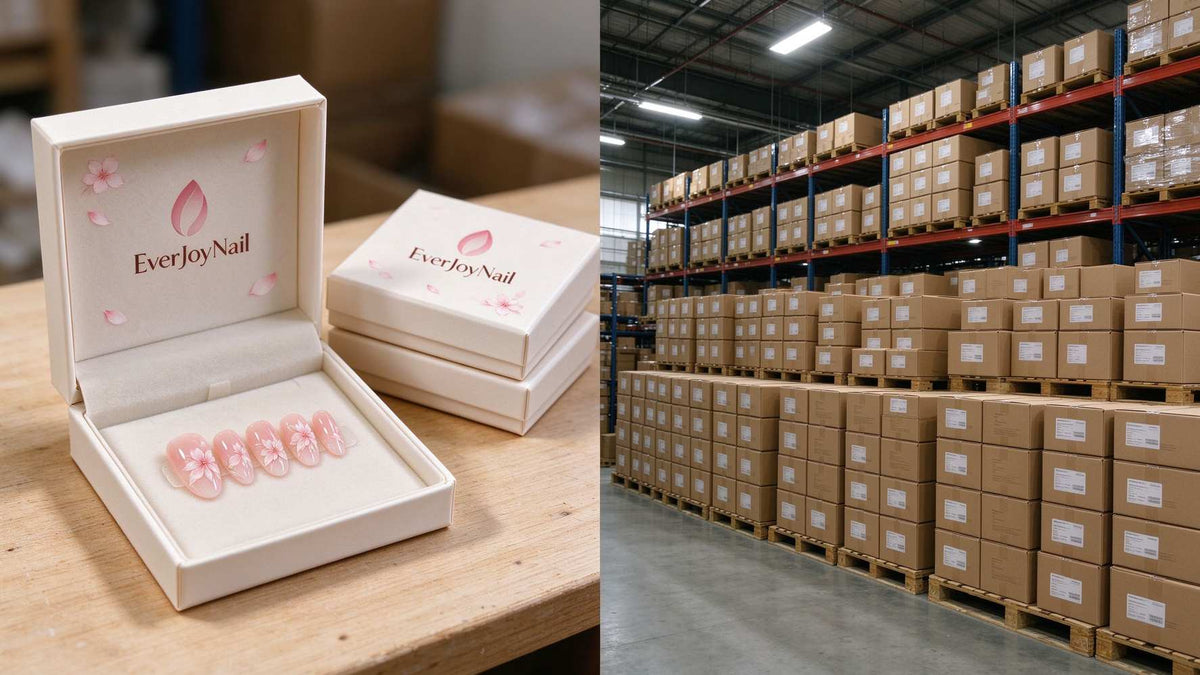
Small-batch and mass-produced press-on nail sets solve different purchasing problems. Small-batch production can limit initial inventory exposure and support design testing; mass production can be more suitable when demand, specifications, and replenishment needs are already understood. Neither model is automatically cheaper, faster, or better for every brand.
At EverJoy, the stated minimum for the applicable handmade-set offer is 5 sets per design. Mass-production MOQ, pricing, customization, lead time, and QC depend on the manufacturer and the project. Confirm current terms in writing before placing an order.
Quick decision guide
| Your situation | Starting point to evaluate | Why it may fit |
|---|---|---|
| Testing a new design or market | Small batch | Limits the first inventory commitment while you collect sales feedback |
| Need a highly specific design | Small batch or a custom program | A smaller run may be easier to review, subject to supplier capability |
| Reordering a proven bestseller | Mass production or a larger batch | Volume may improve unit economics if demand is reliable |
| Need a limited seasonal release | Small batch | Helps match quantity to a defined campaign window |
| Need repeatable stock across many channels | Mass production | A documented specification and batch plan may support replenishment |
| Need both exclusives and core items | Hybrid portfolio | Different designs can use different production models |
Use this table as a starting hypothesis, not a supplier promise. Validate it against your forecast, cash position, storage, and written quotation.
Small-batch vs. mass production: the main trade-offs
| Decision factor | Small-batch production | Mass production |
|---|---|---|
| MOQ | Can be lower, but varies by maker; EverJoy states 5 handmade sets per design for the applicable offer | Often set at a larger quantity, but there is no universal industry minimum |
| Customization | May be practical for reviewed custom work; confirm design, material, and sample capability | May prioritize existing specifications; custom development may require separate MOQ and tooling terms |
| Unit cost | May be higher because setup and labor are spread across fewer sets | May be lower at volume, but freight, storage, defects, and unsold stock affect total cost |
| Cash and inventory risk | Lower initial quantity does not eliminate sampling, shipping, or unsold-stock risk | Greater upfront commitment and holding exposure if demand is uncertain |
| Lead time | May include design review and per-set production; capacity varies | May include queue, production, inspection, and shipping; capacity and order size matter |
| Quality control | May involve more individual-set review; confirm the actual inspection record | May use an approved sample and batch inspection plan; confirm sampling level and defect handling |
| Consistency | Handmade variation may be visible and should be defined | Repeatability depends on the approved specification, materials, process, and controls |
| Best evidence | Sample approval and customer feedback | Sales history, forecast accuracy, replenishment data, and production records |
The right comparison is total landed cost and business risk, not unit price alone.
MOQ and order structure
Ask every supplier to define MOQ by design, color, size set, packaging, and total order. Also confirm:
- whether sample quantities count toward the production MOQ;
- whether several designs can be mixed in one order;
- whether packaging has a separate minimum;
- whether the MOQ changes for custom artwork or 3D elements; and
- which quantity is used in the quotation and production schedule.
EverJoy’s 5-set-per-design statement applies to the applicable handmade-set offer. It should not be generalized to every product, packaging option, or custom project.
Customization and approval
Small-batch work can be a useful format for reviewing a new design, but “small batch” does not automatically mean unlimited customization. Confirm whether the supplier can provide:
- design feasibility review;
- artwork or sample previews;
- the requested shape, length, finish, and 3D elements;
- a documented approval version; and
- a clear process for changes after approval.
Mass production can also support custom work, but it may require a separate development process, tooling, artwork setup, or higher quantity. Ask for those conditions instead of assuming that catalog production and custom production use the same terms.
Cost: compare the full order, not only the set price
Build a simple landed-cost worksheet for each option:
product + sampling + artwork/setup + packaging + freight + duties/taxes + inspection + storage + expected rework or defect cost
Then compare the result with the quantity you expect to sell, not only the quantity you can order. A lower quoted unit price can be offset by excess inventory, slow-moving designs, or a larger cash commitment. A higher small-batch price can be worthwhile when it provides information before a larger purchase, but that value should be measured through sell-through and reorder data.
Lead time and replenishment
Separate the timeline into design approval, sampling, production, inspection, and shipping. Ask the supplier to state which steps are included in the quoted lead time and which event starts the clock.
For a proven item, also ask:
- whether the same materials and packaging will be available for reorders;
- how forecast changes affect the production slot;
- how an out-of-stock risk will be managed; and
- whether the supplier can keep the approved reference sample or specification on file.
“Faster at scale” is not a universal rule. A large order can require a longer queue, while a small order can be delayed by sampling or capacity limits.
QC and consistency questions
Do not infer QC quality from the production label. Ask for the actual control plan:
- What is checked on each set or sampled from the batch?
- Which visual, dimensional, packaging, and attachment defects are recorded?
- What approved sample or specification is the lot compared with?
- What happens when a defect is found?
- Who pays for rework, replacement, or additional inspection under the agreement?
Hand-painted sets may show intentional variation. Mass-produced sets may be more repeatable, but repeatability still depends on the process and specification. Define acceptable variation in writing.
A four-stage scaling framework
Stage 1: Test
Use a small quantity to test design appeal, fit, pricing, and channel response. Record sell-through, returns, customer comments, and defects rather than relying on impressions.
Stage 2: Early launch
Keep the approved design and packaging documented. Confirm whether the supplier can repeat the same finish and size assortment before ordering more inventory.
Stage 3: Proven demand
Compare larger-batch pricing with forecast accuracy, storage, cash flow, freight, and replenishment lead time. Scale only when the data supports the added commitment.
Stage 4: Portfolio management
Use the production model by SKU: small batch for limited or experimental designs, larger production for repeatable core items, and a documented review point for switching models.
Supplier comparison checklist
- [ ] MOQ is stated by design and packaging structure.
- [ ] Sample cost, approval steps, and revision conditions are written down.
- [ ] Customization capability is confirmed for the requested materials and finish.
- [ ] Lead time is separated into approval, production, inspection, and shipping.
- [ ] QC method, defect definition, and remedy are documented.
- [ ] Unit price is compared with total landed cost.
- [ ] Forecast, storage, and cash-flow limits are included in the decision.
- [ ] Reorder terms and approved specifications are clear.
- [ ] Usage rights, exclusivity, packaging artwork, and image rights are addressed where relevant.
Frequently asked questions
Which is better: small-batch or mass-produced press-on nails?
Small batch can fit testing, limited releases, or reviewed custom work. Mass production can fit proven designs and repeatable volume. The better choice depends on demand evidence, cash, storage, customization, and supplier terms.
What is the MOQ for small-batch press-on nails?
MOQs vary by maker and project. EverJoy states 5 handmade sets per design for the applicable offer. Confirm the current product, packaging, sample, and mixed-design conditions in the quotation.
Is mass production always cheaper?
Not necessarily. A lower unit price can be offset by freight, duties, inspection, storage, defects, and unsold stock. Compare total landed cost at the quantity you expect to sell.
Is small-batch production always faster?
No. Sampling, design approval, supplier capacity, and shipping affect the schedule. Ask for milestone dates and written confirmation for either model.
Can I use both production models?
Yes. A hybrid portfolio can assign small-batch production to new or limited designs and larger production to proven core items, subject to each supplier’s terms.
Choose a production path
Share your designs, expected quantity, target market, packaging needs, and timing. Ask the supplier to compare the available MOQ, sample, customization, QC, landed-cost, and replenishment options in writing.
This comparison is general purchasing information. MOQ, pricing, customization, lead time, QC, packaging, and usage terms vary by project. Confirm the current written quotation and agreement before ordering.