
Cat Eye Nails: How Magnetic Gel Creates the Moving Light
A magnet moves reflective particles in uncured cat eye gel. The same gel can create a defined light band or a soft velvet glow; the base color changes how strongly either effect reads.
A buyer sends a photo of a burgundy nail with a bright stripe down its center. As the hand turns, the stripe seems to move. Is it foil, a printed pattern, or glitter? On a cat eye nail, the effect comes from a magnet held near the gel before it cures. That distinction matters when the photo becomes a request for custom press-on nails: “cat eye” alone does not tell a maker what shape of light to create.
What are cat eye nails?
Cat eye nails are nails coated with magnetic gel polish, a colored coating that hardens under a UV or LED lamp. Fine magnetic particles can move through the gel while it is still wet. A magnet draws them into a pattern; once the gel is cured, the pattern stays in place. Concentrated particles reflect light as a bright band against a darker field. The band appears to shift when the nail or light source moves. The term chatoyancy describes a similar moving band of light in cat's-eye and tiger's-eye gemstones.
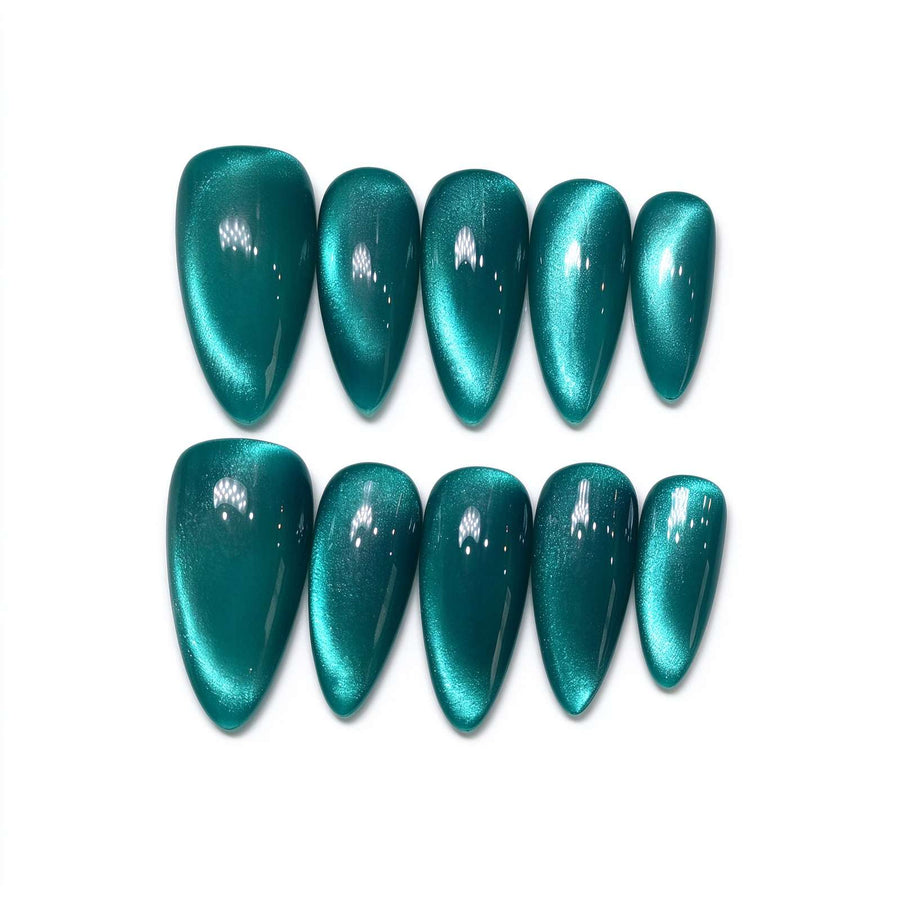
Look at this peacock-green press-on set. Each nail has a vertical band running from the cuticle end (the end nearest the natural nail's base) toward the tip, with darker color on either side.
The light is an optical effect of particle placement, rather than a strip attached to the nail. Scratch Magazine's September 4, 2026 article by Jess Watts, “Cat eye & velvet nails: what's the difference & how are they created?”, explains the distinction between a focused cat eye band and a diffused velvet finish. Jessica Zhang's April 3, 2026 article for Magic Finger Cosmetics, “The Science and Secrets of Cat Eye Nails”, describes how magnetic particles respond to the magnet before curing. For related nail terms, see our press-on nail glossary.
How do you do cat eye nails, and what makes velvet different?
The essential sequence is short: apply cat eye gel, hold a magnet close to the uncured surface without touching it, shape the reflection, then cure the gel. A gap of roughly 2-5 mm gives the maker room to move the magnet without marking the coating. The exact position and motion matter more to the final look than the name on the gel bottle.
Hold a bar magnet over the nail and the particles can gather into a defined band. Move the magnet off center and the band shifts with it; angle it and the band becomes diagonal. A narrow magnet tip can pull the reflection into a finer line. A wider, softer band has a different character even when the base color stays the same.
For a velvet effect, the reflection is spread across the nail instead of concentrated in one stripe. Makers can move a magnet parallel to the surface or work around the edges to disperse the highlight. The result looks like an even, soft shimmer. Cat eye and velvet are therefore two ways of arranging particles in the same type of magnetic gel, not necessarily two separate materials.

Photo 2: A burgundy French set sold on the site, with a broader, softer band than the green set above.

Photo 3: A gray-blue set sold on the site. The reflection is more dispersed, approaching a velvet-like glow without a sharply defined edge.
There is a timing detail behind a consistent set. While the gel remains liquid, the particle pattern can soften. A flash cure means a brief exposure under a UV or LED lamp to hold the newly shaped pattern before the remaining cure. In production, the maker shapes and sets the effect on each nail rather than leaving a whole tray of wet, magnetized nails waiting. That small step is why two sets made with the same gel can still differ in how even their light bands look.
Why cat eye is an entry-level effect in wholesale pricing
For a press-on nail maker, the magnetic effect adds a short shaping step after applying gel. It does not require an artist to paint every line or sculpt a three-dimensional flower on every nail. That shorter labor time is why a straightforward cat eye design can sit in an entry-level wholesale price tier. It says nothing about the quality of the gel or the finished nail.
Salon pricing answers a different question: a salon may charge a client extra for the time and service of applying a cat eye manicure. That retail service price does not set the wholesale price of a finished press-on set. For the labor involved in painted details, read how hand-painted press-on nails are made. Our hand-painted versus mass-produced comparison explains why labor-intensive decoration changes the cost picture.
How to describe the effect for a custom order
Start with the shape of the light. Is it a fine line, a broad band, or a full-surface velvet glow? Should a band run vertically, diagonally, or curve toward the tip? Then specify the depth of the base color. A dark burgundy or black base generally gives the highlight more contrast; a pale pink or milky white base makes it subtler. A light base is a poor match for a reference image whose appeal depends on a very sharp, high-contrast stripe.
Attach a reference photo to those two decisions. For example: “Burgundy base, one narrow vertical light band centered on each nail; please match the attached photo.” That gives the maker a clearer target than “burgundy cat eye” or a photo alone. During sampling, compare the band under moving light as well as in a still photo.
Our current range includes more than 20 cat eye designs across different colors and light patterns. A designer on the team has focused on cat eye effects for nine years, and one paid customer sample request included a burgundy cat eye design. Those are examples of the work behind this guide, not a promise that every reference image can be reproduced exactly. Send the desired light shape, base color and reference through the inquiry page so the sample can be discussed against a specific target.
Frequently asked questions
What is cat eye gel polish?
It is gel polish containing magnetic reflective particles. Before the coating cures, a magnet can move those particles into a visible pattern; curing fixes that pattern in place.
Are velvet nails made with a different gel?
Not necessarily. A maker can use the same type of magnetic gel and spread the reflection across the nail for a soft velvet look instead of drawing it into one defined cat eye band.